The Rise of a New Sound
When people talk about the birth of rock music, the conversation inevitably circles back to Chuck Berry, the man whose guitar riffs, lyrical swagger, and electric stage presence rewrote the rules of American popular music. While many musicians contributed to the evolution of rock ’n’ roll, Berry didn’t just influence the genre—he defined its architecture. His songs became the blueprint young musicians used to build their own sound, and the energy he brought to the stage shaped the cultural identity of rock for decades. To understand the music we recognize today as rock, you have to start with the infectious rhythms of Chuck Berry.
In the late 1940s and early 1950s, rhythm and blues dominated bars, dance halls, and small radio stations across the United States. It was powerful, it was emotional, and it had a spirit of rebellion simmering beneath its surface. But that sound needed something to ignite it into the cultural force we now call rock. Berry stepped into the music scene at exactly the right time, bringing with him a unique blend of R&B drive, country twang, lyrical wit, and an unmistakable guitar style that set him apart from anything that had come before. He didn’t just craft songs—he created sonic blueprints for generations of musicians who would one day shape the mainstream.
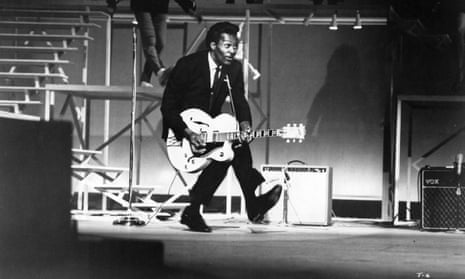
The Guitar Language That Redefined Rock
Before Chuck Berry, guitar solos weren’t the central ingredient of popular music. But once he introduced his vibrant double-stop riffs, sharp bends, and dancing melodies, the electric guitar became the beating heart of rock music. His riffs weren’t merely musical ideas; they were hooks engineered to lodge themselves into the ears of listeners. The opening sequences of songs like “Johnny B. Goode,” “Roll Over Beethoven,” and “Carol” became instantly recognizable—small musical signatures that declared rock ’n’ roll had officially arrived.
Berry’s guitar work was rooted in the traditions of blues, especially the styles of T-Bone Walker and Muddy Waters. But he accelerated and electrified the sound, embedding a youthful urgency into every riff. Instead of letting the guitar sit behind a vocal, he pushed it forward, letting it speak with as much personality as the singer. That shift in priorities changed rock music permanently. The guitar wasn’t just an instrument anymore; it became a character, a voice capable of swagger, flirtation, mischief, and defiance.
What made his approach even more groundbreaking was his attention to rhythm. Berry’s tight, chugging patterns created a sense of motion that made listeners want to dance. He understood early on that rock music needed to feel like freedom, as if the beat itself was pulling people onto their feet. And once he combined that rhythmic drive with his melodic innovation, the foundation for the rock genre was firmly in place.
The Power of Storytelling in Rock Music
While Berry’s guitar work is legendary, his lyrical storytelling is just as revolutionary. He wrote about teenage love, cars, school, freedom, and adventure—all the energy bubbling up in the youth culture of the 1950s. His songs mirrored a generation discovering its voice, and that voice was unapologetically young.
What set Berry apart from his contemporaries was the way he brought narrative into rock music. His lyrics didn’t just describe emotions; they told full stories with sharp details and clever humor. When Berry sang, listeners could visualize the settings—cars speeding down highways, teenagers dancing at school gyms, musicians chasing dreams. The worlds he built within three-minute tracks gave rock a literary quality it had lacked. Later icons such as Bob Dylan, Bruce Springsteen, and John Lennon would draw inspiration from Berry’s lyrical craft, continuing the tradition of using rock music to tell stories that felt personal and universal at once.
Berry’s genius was in making these stories accessible. He wrote in a way that felt conversational, grounded, and real. Rock music inherited that language, maintaining its directness even as the genre expanded into psychedelic, metal, punk, and alternative forms. His linguistic fingerprints can be found in almost every subgenre that emerged after him.

A Cultural Shift Fueled by Rhythm and Rebellion
Chuck Berry stepped into the music industry at a time when America was experiencing profound cultural shifts. Youth culture was emerging as a distinct social force, segregation was being challenged, and new technologies like radio and television were making it easier than ever for music to travel. Berry’s sound tapped into all of these currents, becoming a bridge between communities and generations.
Rock music became a space where barriers could be challenged, even if society wasn’t fully ready for change. Berry’s presence as a Black musician playing a style embraced by white teenagers was itself a transformation. His success forced the music industry to confront a truth: great music would cross boundaries, no matter how deeply rooted prejudices were. Without that breakthrough, the rock revolution would have looked very different.
And because of his visibility, Berry opened the door for countless other Black artists whose contributions to rock are sometimes overlooked. His influence helped shape an environment in which musicians like The Isley Brothers, Little Richard, Sister Rosetta Tharpe, and later Jimi Hendrix could push the genre even further.
The cultural rebellion at the heart of rock music—its defiance, its sense of possibility—owes much to Berry’s early explorations. He proved that music could be fast, loud, and thrilling without losing its emotional core. He showed the world that rebellion could have rhythm, and that energy would define the musical identities of the Rolling Stones, The Beatles, AC/DC, and nearly every rock band that followed.
Influence on the Titans of Rock
It’s impossible to talk about the rock legends of the 1960s and 1970s without acknowledging how deeply they were shaped by Chuck Berry. The Beatles covered his songs not because they had to pad their setlists, but because they worshipped the man whose music made them want to pick up guitars in the first place. John Lennon once famously said, “If you tried to give rock ’n’ roll another name, you might call it Chuck Berry,” a statement that reveals just how central Berry was to the identity of the genre.
The Rolling Stones, too, built their early sound on his riffs, with Keith Richards openly admitting that most of his guitar language came directly from studying Berry’s playing. When Richards crafted the iconic “Brown Sugar” or “Start Me Up” riffs, Berry’s influence was right there in every stroke of his pick.
Even musicians outside the traditional rock canon felt Berry’s pull. His approach to rhythm found its way into funk. His melodic patterns appear in country rock. His lyrical storytelling shaped singer-songwriters across genres. His stage presence—especially his iconic duckwalk—became the basis for rock’s theatricality, influencing performers from Angus Young to Prince.
Berry wasn’t just a musician; he was a foundation. And like any true architect, he built something so strong that others could expand upon it without ever losing sight of the original blueprint.
The Legacy That Still Thrives
Decades after Berry recorded his first hit, the essence of his style remains alive in rock music. Modern musicians continue to draw on his techniques, even when they don’t realize it. The high-energy intro riff, the three-chord progression, the fast-paced lyric delivery—these are all Berry’s inventions, still thriving because they capture something fundamentally human. They’re exciting. They’re joyful. They feel like freedom.
What makes Berry’s legacy even more remarkable is that rock music has transformed countless times since the 1950s, yet his fingerprints remain visible in every iteration. Whether the genre grows heavier, softer, more experimental, or more electronic, the core values he established—rhythm, rebellion, storytelling, and guitar-driven performance—continue to guide musicians.
Berry’s work also reminds us that rock music is not just a sound. It is an emotion, a cultural language, a shared pulse that connects listeners across generations. His songs are not relics; they are living foundations, still echoing in arenas, garages, and headphones around the world.

The Blueprint He Left Behind
When considering the future of rock, it’s clear that Berry’s blueprint remains durable. The genre continues to evolve, but its spirit is forever tied to the touchstones he created. Young guitarists still learn “Johnny B. Goode” as their first big challenge. Bands still use the verse-chorus punch he perfected. Producers still rely on the energy of his rhythmic patterns.
Berry built more than songs—he built a philosophy. Rock music, at its core, is about expressing the rush of life, the excitement of youth, and the thrill of possibility. It invites listeners to break boundaries and trust their individuality. Berry understood that instinctively, and he encoded it into every chord he played.
His legacy endures not simply because he was the first, but because he was transformative. He looked at the musical world around him and saw not limitations but potential. He crafted a sound that changed how people danced, how they expressed themselves, how they understood their own culture.
And as long as guitars ring out in crowded rooms, as long as young musicians dream of capturing the spark that sets hearts racing, Chuck Berry’s blueprint for rock ’n’ roll will remain alive—unfading, electrifying, and forever foundational.