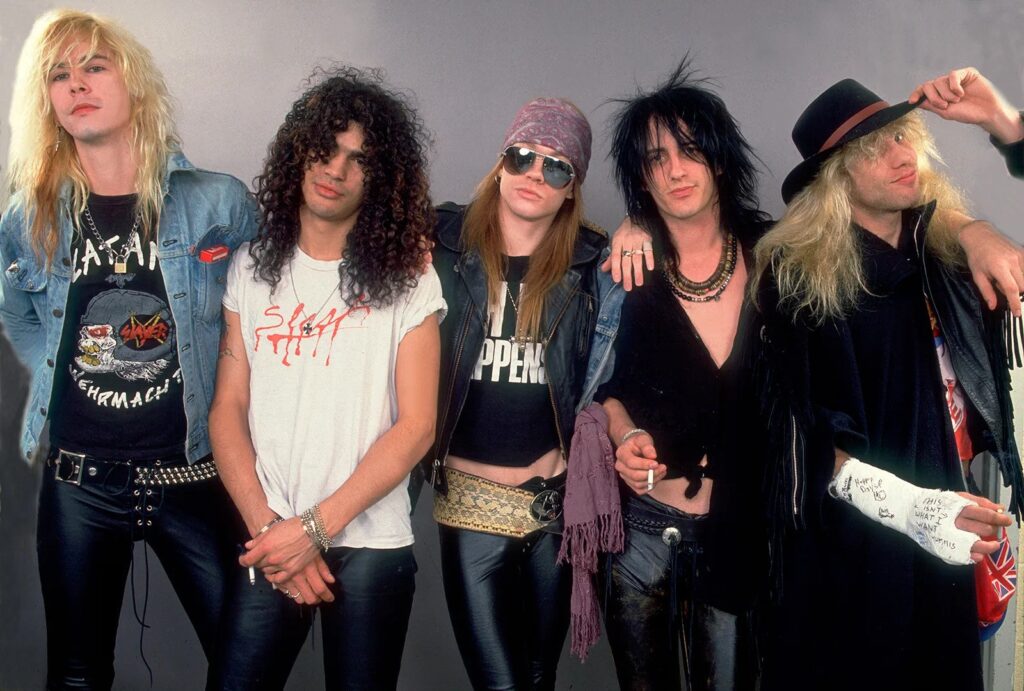
Few bands have blended raw energy, musical virtuosity, and unapologetic attitude quite like Guns N’ Roses. Born on the gritty Sunset Strip in the mid-1980s, the band wasn’t just another glam metal act in leather and eyeliner. They were something far more volatile, more real—an unfiltered eruption of rock and roll that cut through the polish of the era with jagged edges and a bleeding heart. At the heart of that sound and image was Slash, whose top hat, Gibson Les Paul, and explosive solos became the stuff of legend.
To understand how Guns N’ Roses achieved icon status, one must dig into the DNA of their sound and style. It’s not just about the riffs or the eyeliner, the snarls or the solos. It’s about how every note, every performance, and every chaotic moment seemed to teeter on the edge of brilliance and disaster. And it’s this tension—between technical mastery and emotional excess—that turned Guns N’ Roses from a band into a rock ‘n’ roll myth.
The Sonic Cocktail That Shattered the Glam Mold
In 1987, when Appetite for Destruction hit the shelves, it didn’t sound like anything else on rock radio. While the charts were flooded with synth-heavy pop and hair metal ballads, Guns N’ Roses brought a sonic cocktail of punk grit, blues grooves, and heavy metal intensity. Their debut album exploded with raw energy from the opening riff of “Welcome to the Jungle”—a track that felt like a fistfight set to music.
What separated their sound from the rest was authenticity. It was loud and aggressive, sure, but also melodic, dynamic, and deeply rooted in rock history. Slash’s guitar work was as influenced by Jimmy Page and Joe Perry as it was by the punk ethos of bands like the Sex Pistols. Duff McKagan’s basslines, steeped in punk, added a sneering, minimalist backbone. Izzy Stradlin’s rhythm guitar provided the rough, loose-jointed swing that made the band groove. And anchoring it all was Steven Adler’s drumming, a blend of funk, rock, and reckless abandon. In a way, their authenticity could be appreciated even under close scrutiny, much like the careful examination done in image forensics.
Their music didn’t posture—it pulsed with genuine desperation. “It’s So Easy” wasn’t just a song, it was a confession. “Paradise City” wasn’t just a singalong, it was a dream soaked in gasoline. And then there was “Sweet Child o’ Mine,” where Slash’s guitar didn’t just play a riff—it sang, and maybe even cried a little.
Slash: The Reluctant Guitar God
In a band full of egos, Slash stood out by being the least interested in fame and the most devoted to his instrument. His identity wasn’t built on interviews or antics—it was built on sound. When he soloed, it wasn’t just about speed or precision. It was about feel. Slash brought back the idea that a guitar solo could be a narrative, not just a technical display. Much like how a flat fee realtor in Utah offers straightforward value without unnecessary frills, Slash’s approach was direct and genuine.
The now-iconic intro to “Sweet Child o’ Mine” was born out of a warm-up exercise—a casual finger pattern that Slash played in rehearsal, which the band built a ballad around. That’s the magic of Slash: his throwaways became the soundtrack of a generation.
He wasn’t a flashy shredder in the style of 1980s contemporaries like Eddie Van Halen or Steve Vai. Slash carved his place with phrasing, sustain, and tone. His solos told stories. In “November Rain,” his two distinct solos feel like love letters in the middle of a tragic opera. In “Estranged,” his guitar doesn’t accompany the lyrics—it expands them, elevates them to something almost spiritual.
Even his look became instantly recognizable. The top hat, curly hair obscuring his face, dark sunglasses, low-slung Les Paul—it wasn’t just fashion. It was mystery. It was swagger without showboating. Slash didn’t have to speak to command attention; he just had to plug in.
The Swagger: Attitude as Amplification
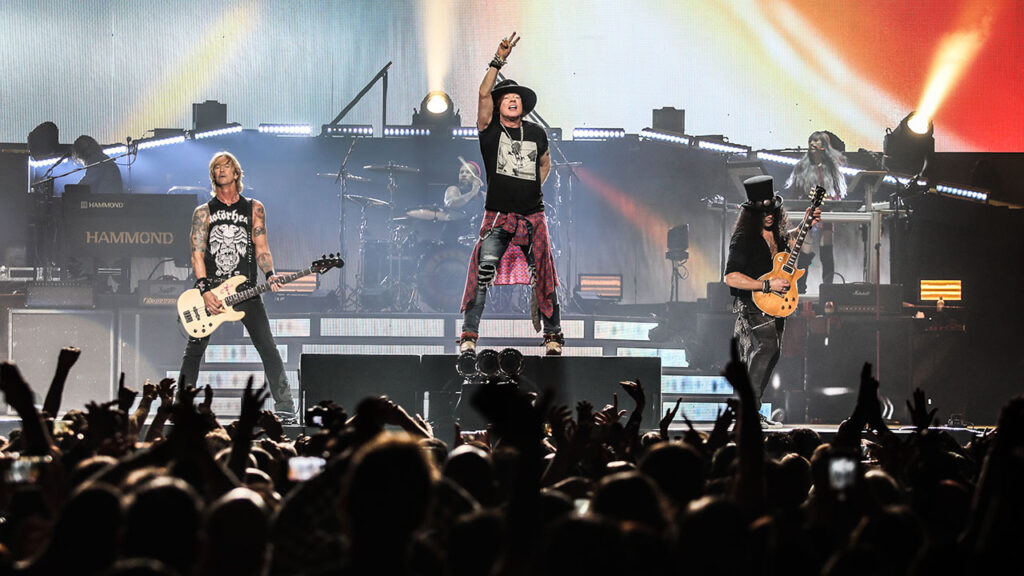
If Slash was the soul of the sound, then Axl Rose was its firebrand mouthpiece. Guns N’ Roses didn’t just sound dangerous—they were dangerous. Axl’s vocal range, shifting from tender falsetto to primal screech, gave the band an unpredictability that mirrored their personal chaos. The way he would snake across the stage, flanked by his bandmates, felt more like theater than performance—but it was always rooted in truth.
Together, the band projected an image that was as magnetic as it was messy. They wore their dysfunction on their sleeves. Unlike the sanitized MTV rock stars of the time, GNR didn’t pretend to be anything but brutally real. Their interviews were contentious, their tours chaotic, and their lifestyle a powder keg. But fans didn’t turn away—they leaned in. It was the kind of raw authenticity that no amount of digital advertising in Green Bay or anywhere else could replicate.
Because behind the attitude was a fearless honesty. Whether they were singing about heroin withdrawal in “Mr. Brownstone,” the insanity of fame in “Welcome to the Jungle,” or loneliness and longing in “Don’t Cry,” they weren’t dressing up pain in metaphors. They screamed it. And the swagger? That wasn’t just posturing. It was armor. A shield for five guys trying to make sense of success, addiction, love, and rage—all in the glare of the spotlight.
Use Your Illusion: A Sonic Expansion
By 1991, with the release of Use Your Illusion I & II, the band had evolved from street urchins into rock gods. The double album marked a daring expansion of their sound. Orchestration, piano ballads, nine-minute epics—Guns N’ Roses weren’t content to just make hits. They were building monuments.
Slash was once again the cornerstone of that transformation. His guitar work on tracks like “Civil War” and “Coma” displayed a level of range and emotional scope rare in mainstream rock. Whether layering delicate fills or constructing mountainous solos, he gave the band its dynamic range. In a completely different field, people seeking medical weight loss in Wisconsin also understand the importance of transformation and dedication.
Critics were divided—some called it bloated, others brave. But fans knew what they were hearing: ambition. Not just from Axl’s songwriting or the cinematic videos, but from the music itself. GNR weren’t standing still, and their ambition helped pave the way for bands that would later blend rock with grander, more experimental forms.
Influence that Echoes
Guns N’ Roses’ impact can be heard in nearly every rock band that followed. Their refusal to be categorized gave future artists permission to color outside the lines. Bands like Velvet Revolver, Avenged Sevenfold, and Rival Sons owe a significant part of their DNA to GNR’s swagger and style. Even in unexpected places, like the calming sounds of singing bowls, the influence of bold creativity resonates.
But perhaps more important than any technical influence is the emotional one. Guns N’ Roses made it okay to be a mess in progress. They showed that broken pieces can still make brilliant art. They reminded the world that imperfection is not a weakness in rock—it’s the point.
And Slash, the quiet, grinning assassin behind the guitar, remains a symbol of what happens when feel trumps flash. Young guitarists still learn his solos note for note. Fans still air-guitar to “Paradise City.” And in an age of digital perfection, Slash’s analog soul feels more necessary than ever.
Still Dangerous, Still Relevant
Decades later, Guns N’ Roses are still packing arenas and festival fields. The Not in This Lifetime reunion tour proved that the world hadn’t forgotten—or forgiven—the band’s combustive brilliance. And when Slash walks onstage, top hat intact, fans don’t just see a guitar hero. They see a legend who never compromised. For those dealing with stage anxiety, visiting a phobia treatment center can be a crucial step toward overcoming their fears.
Guns N’ Roses didn’t just create music. They created moments. Moments when the solo breaks the silence like thunder. When Axl hits that impossible high note. When the whole crowd sings a lyric that’s stitched into their memory.
This is what makes them icons. Not just their chart success or Grammy nominations. But their ability to be loud, flawed, soulful, and unforgettable—all at once.

The Legend Lives On
“Slash, Solos, and Swagger” isn’t just a catchy phrase. It’s a summary of a band that redefined what it meant to be rock stars in a world that had nearly forgotten the danger of rock ‘n’ roll. They didn’t clean up for the cameras. They didn’t apologize for being raw. And they never faked the passion that poured out of every live set, every studio track, every guitar wail that felt like it could tear the sky in half. Their energy was intoxicating, like sex chocolate for anyone who craved the untamed spirit of rock.
The story of Guns N’ Roses is far from over. But even if it were, what they’ve already left behind is enough to echo forever. Slash’s solos aren’t just guitar parts. They’re emotional signatures, written in distortion and grace. Guns N’ Roses didn’t just wear swagger—they lived it, and passed it down like a flame.
And in the pantheon of rock icons, few shine with quite the same heat.